 Osmosis
Osmosis liquidity pools - position types, ranges, and rewards
Osmosis liquidity pools offer classic pool shares and concentrated positions for supplying tokens to automated market maker swaps. Classic positions spread liquidity across the full price curve. Concentrated positions let you select a price range and earn swap fees while that range is active. The choice affects token exposure, fee accounting, and access to deposited assets. Range width matters alongside the pool’s trading activity. Incentive eligibility and any lock attached to a position add separate conditions.
Deposits at the pool’s live price
An in-range concentrated deposit normally requires both pool assets, with their proportions determined by the current price and selected boundaries. Position creation calculates those amounts when the transaction executes. Minimum token amounts protect the deposit against an unacceptable change between the preview and execution. If the calculated contribution falls below either applicable minimum, creation fails. These limits concern the tokens entering the position. They don’t promise a future withdrawal value or prevent the position’s composition from changing during subsequent trades. The pool’s asset denominations must also match the tokens supplied.
A price move can invalidate a previously acceptable preview. A refreshed calculation reflects the new pool state without requiring wider execution limits. If the price crosses a boundary, the selected range can also require a different token mix. A rejected creation doesn’t establish an active liquidity position.
Classic shares and concentrated positions
Classic pool shares represent a proportional claim on pooled reserves; concentrated positions attach liquidity to individually selected price boundaries. A classic weighted pool uses asset weights to shape its pricing curve. Providers receive fungible liquidity provider (LP) tokens representing their share of that pool. They don’t set personal upper and lower price limits. The pool’s weights describe value proportions, so equal token quantities aren’t a universal deposit requirement. Swaps change the underlying reserves, and accrued pool fees increase the assets backing the shares. Redeeming shares returns the applicable portion of those reserves.
Stable curves and contract-defined pools
Stableswap pools use a curve designed for assets expected to trade near a particular relative price. This concentrates trading depth through the pool’s curve, without each provider choosing a personal range. A growing reserve imbalance increases price impact. The curve doesn’t maintain an asset’s peg or guarantee its redemption value. Osmosis also routes through CosmWasm pools, whose contracts define their mechanics. Shared swap routing doesn’t give every contract the same deposit or withdrawal rules.
Individual concentrated positions
A concentrated position has its own identifier, boundaries, liquidity amount, and accrued rewards.
Range width and changing token exposure
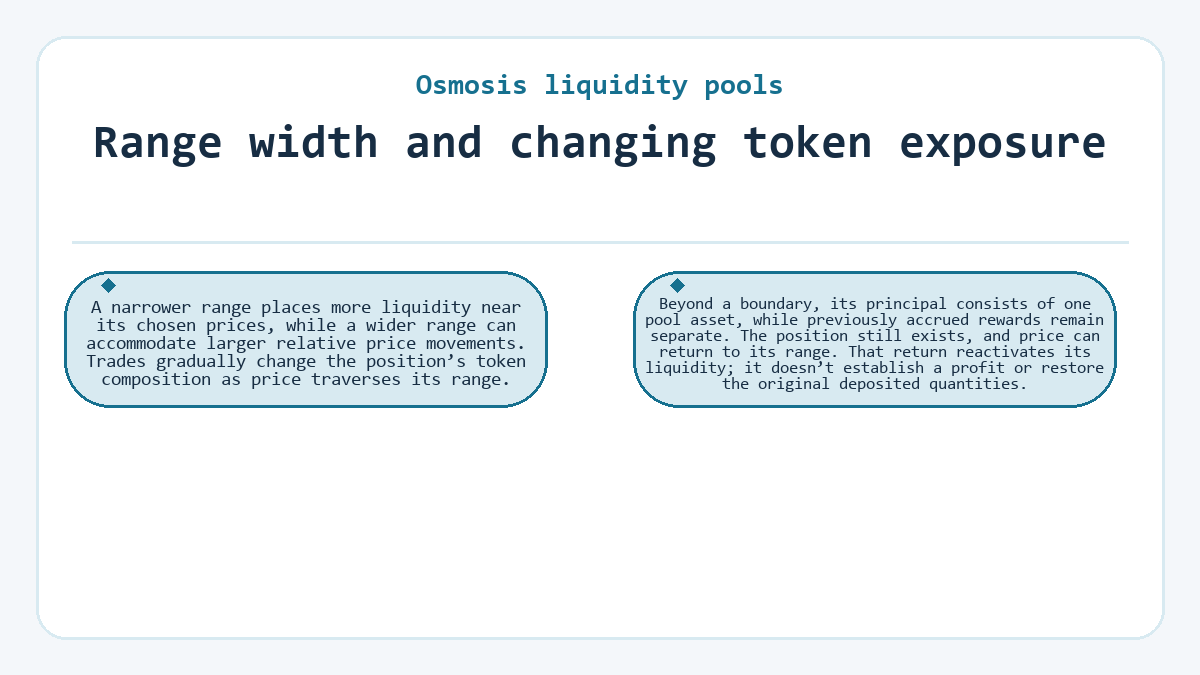
A narrower range places more liquidity near its chosen prices, while a wider range can accommodate larger relative price movements. Trades gradually change the position’s token composition as price traverses its range. Beyond a boundary, its principal consists of one pool asset, while previously accrued rewards remain separate. The position still exists, and price can return to its range. That return reactivates its liquidity; it doesn’t establish a profit or restore the original deposited quantities.
Capital inside the selected band
Narrow boundaries
Concentration can increase a deposit’s share of active liquidity while the pool trades inside its range. It also places the boundaries closer together. Volatility can move the price beyond them sooner, leaving the position inactive. The range alone can’t establish earnings: trading volume and competing active liquidity also influence the fees available to a position.
Wide boundaries
A wider band spreads the same capital over more prices. With the same starting price inside both bands, extending the boundaries increases the price interval the position can cover. Full-range concentrated liquidity extends this choice to the protocol’s supported extremes; it doesn’t recreate a classic pool’s receipt-token model.
How do swap fees differ from liquidity incentives?
Swap fees come from trades using the pool; liquidity incentives distribute separately funded rewards under their own eligibility conditions.
In concentrated pools, the position’s share of active liquidity determines its participation in swap-fee accrual. Trades outside its range don’t generate new fees for that position. Concentrated-position swap fees accrue separately from the deposited liquidity. The protocol calls these fees spread rewards. A claim transfers accrued rewards to the owner; it doesn’t enlarge the position’s liquidity. Classic pool fees instead increase the reserves backing LP shares, so an ordinary share redemption includes their effect.
Incentive gauges distribute funded rewards to qualifying liquidity. Their funding, distribution schedule, and eligibility determine whether an additional reward exists.
Concentrated incentives accrue against active liquidity, while each incentive record’s minimum uptime determines when its rewards become claimable. Collecting incentives early can forfeit rewards whose uptime requirement hasn’t matured. Uptime requirements affect reward maturity without automatically locking deposited liquidity. An annualized reward display also changes with trading activity, eligible liquidity, and reward funding. It doesn’t describe a fixed payment stream. Network transaction fees remain a separate cost when creating, claiming from, or withdrawing a position. A trader’s total swap charge can also include a protocol taker fee, separate from the position’s spread rewards.
Position value against holding the tokens
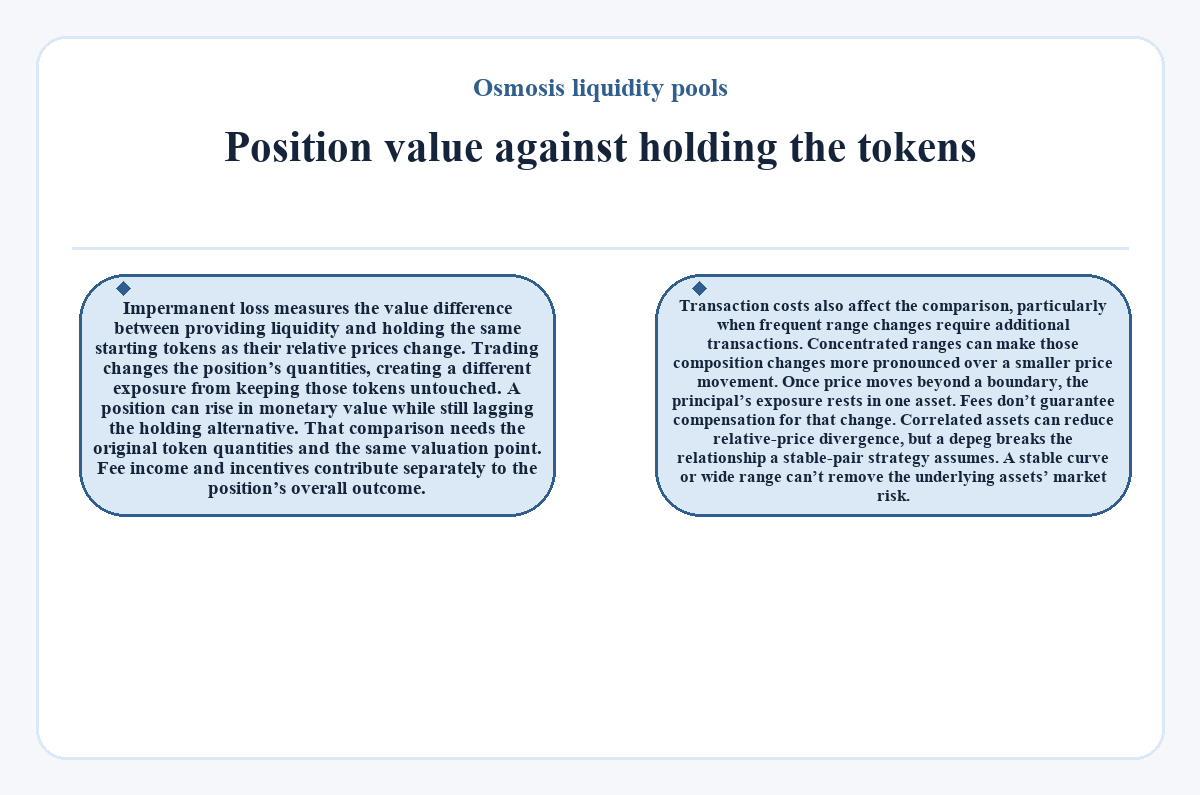
Impermanent loss measures the value difference between providing liquidity and holding the same starting tokens as their relative prices change. Trading changes the position’s quantities, creating a different exposure from keeping those tokens untouched. A position can rise in monetary value while still lagging the holding alternative. That comparison needs the original token quantities and the same valuation point. Fee income and incentives contribute separately to the position’s overall outcome. Transaction costs also affect the comparison, particularly when frequent range changes require additional transactions.
Concentrated ranges can make those composition changes more pronounced over a smaller price movement. Once price moves beyond a boundary, the principal’s exposure rests in one asset. Fees don’t guarantee compensation for that change. Correlated assets can reduce relative-price divergence, but a depeg breaks the relationship a stable-pair strategy assumes. A stable curve or wide range can’t remove the underlying assets’ market risk.
Locks, withdrawals, and superfluid eligibility
An active underlying lock delays access to the assets in classic shares or a concentrated position. For bonded classic shares, the unlocking countdown starts when unlocking begins, using the lock’s recorded duration. Holding bonded shares for that duration doesn’t automatically unlock them. An unlocked concentrated position supports partial or full withdrawal, subject to ownership and available liquidity. If an underlying lock exists, it must mature first. Every concentrated withdrawal also processes the position’s incentives, so even a partial withdrawal can forfeit rewards whose uptime requirement hasn’t matured. Full withdrawal additionally collects outstanding spread rewards and removes the position.
Superfluid staking adds validator delegation to eligible locked liquidity. It supports qualifying classic shares and full-range concentrated positions, with eligibility controlled by the registered superfluid assets. A custom narrow range doesn’t satisfy the full-range requirement for concentrated superfluid staking. This option adds staking exposure: validator slashing can reduce the underlying locked collateral. Its lock conditions therefore belong in the position choice alongside range coverage and reward eligibility.
Tick spacing and asset units
Ticks express concentrated price boundaries as discrete indices, and the pool’s tick spacing restricts which boundaries a position can use. The underlying pool configuration supplies the assets and spread factor. Module parameters constrain authorized configuration choices, so a remembered fee tier or spacing list can become stale.
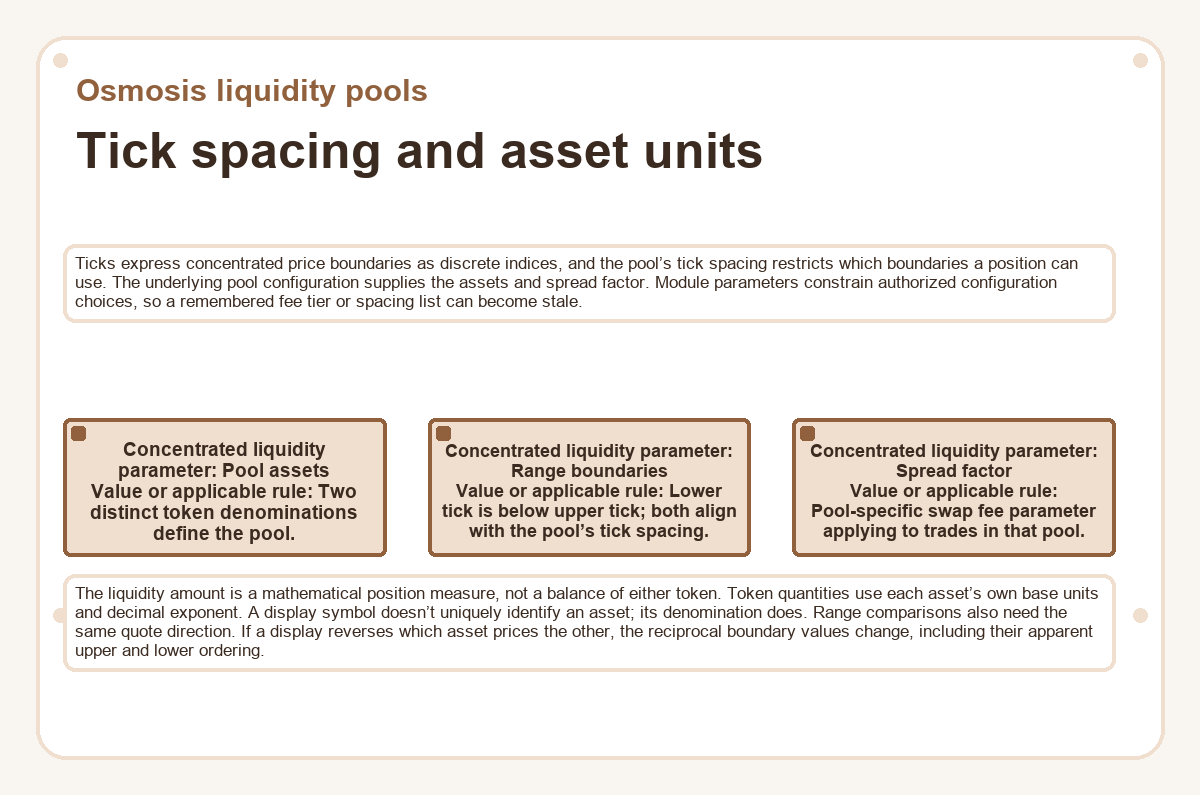
| Concentrated liquidity parameter | Value or applicable rule |
|---|---|
| Pool assets | Two distinct token denominations define the pool. |
| Range boundaries | Lower tick is below upper tick; both align with the pool’s tick spacing. |
| Spread factor | Pool-specific swap fee parameter applying to trades in that pool. |
The liquidity amount is a mathematical position measure, not a balance of either token. Token quantities use each asset’s own base units and decimal exponent. A display symbol doesn’t uniquely identify an asset; its denomination does. Range comparisons also need the same quote direction. If a display reverses which asset prices the other, the reciprocal boundary values change, including their apparent upper and lower ordering.
Helpful answers about Osmosis liquidity pools
Can I open a concentrated position using just one token?
Yes, an already initialized concentrated pool permits a single-token position when its range lies entirely on one side of the current price. The range determines which pool token it requires. A range spanning the current price needs both assets. Initializing a pool’s first position also requires both assets to establish its starting price.
Why can a concentrated deposit leave some supplied tokens in my wallet?
Position creation uses only the token amounts the selected range and current pool price can combine into liquidity. Uneven supplied amounts can leave an excess of one asset. The unused amount stays in the sender’s balance. The executed position’s deposited amounts, rather than the maximum amounts offered, describe what entered the pool.
Does adding tokens recenter an existing concentrated position?
Adding liquidity keeps the existing position’s price boundaries, so it doesn’t recenter an inactive range around a new price. Different boundaries require creating a position with a different range. The ordinary add operation withdraws and recreates the position, restarting incentive uptime and returning a new identifier for subsequent claims or withdrawals. That withdrawal can forfeit immature incentives. This operation rejects actively locked positions and the pool’s last remaining position; superfluid-staked positions use a separate add operation.
Are overlapping concentrated positions allowed in the same pool?
Yes, one address can own multiple concentrated positions in the same pool, including positions with overlapping or identical ranges. Each position retains its own identifier and liquidity accounting. A pool identifier therefore can’t identify an individual deposit. Overlap doesn’t merge the positions or automatically combine their claimable rewards.
Which tokens pay the swap fees on a concentrated position?
Swap fees accrue in the pool tokens traders supply during swaps. Trading in both directions can therefore produce claimable fees in both assets. Liquidity incentives have separate reward denominations determined by their funding. A displayed incentive token doesn’t establish the currency of every swap fee or the composition of the position’s principal.
Is direct migration available between every classic and concentrated pool?
Direct migration requires a governance-established link between the classic pool and its canonical concentrated pool. The supported migration produces a full-range concentrated position. Existing locks or an unlocking process retain their applicable timing through migration. An identical asset pair alone doesn’t establish the required pool link or erase a withdrawal restriction.